

Aging Is Not a Niche Issue
How Saint John’s On The Lake’s Symposium on Aging Continues to Reframe Aging, Purpose, and Belonging
Aging is not a niche issue. It is not something that belongs only to “later,” or to someone else’s family, or to a different season of life. Aging is happening to all of us, all the time — and yet it remains one of the hardest realities to examine in our churches and communities. And aging itself is shifting, just as those who are aging are shifting.
For Rev. Jana Troutman-Miller, Director of Spiritual Care at Saint John’s On The Lake, that gap is exactly why the Symposium on Aging exists. For nearly a decade, Saint John’s On The Lake in Milwaukee has been gathering people for a conversation that touches every life, every parish, and every community: What does it mean to age well — faithfully, honestly, and with dignity — in the world we are living in now?
“I’ve been at Saint John’s for 12 years, and I haven’t really seen the narrative about elders in our churches change all that much. Meanwhile, elders themselves are very different from previous generations. They have different needs, different abilities, different interests — and they are aging in a very different world.”
The Symposium this Year
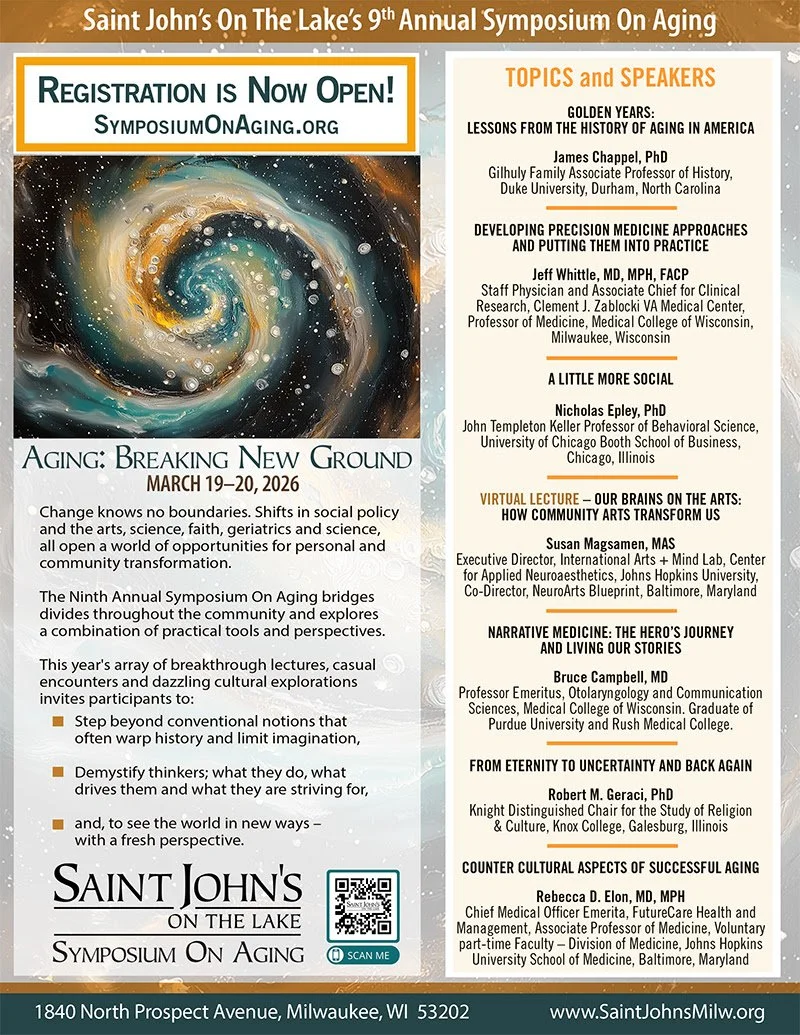
This spring, Saint John’s will host its 9th Annual Symposium on Aging, titled Aging: Breaking New Ground, on March 19–20, 2026. The two-day symposium brings together nationally recognized scholars, physicians, artists, and practitioners to explore aging through history, medicine, storytelling, creativity, social connection, and community life.
For the fourth consecutive year, the Symposium is offered free of charge, including 10.5 hours of continuing education credit, reflecting Saint John’s ongoing commitment to community access, lifelong learning, and care for elders and those who serve them.
But how did the Symposium begin?
The Symposium on Aging grew out of a moment of generosity — and a willingness to imagine something new.
“In 2015, Saint John’s was given a gift of $50,000 from a very generous resident, Nancy Klein Maguire, and her late husband, David,” said Jana Troutman-Miller, Director of Spiritual Care at Saint John’s On The Lake. “They wanted us to do something out of the ordinary — something that showed the wider community the depth of care Saint John’s offers elders.”
Several ideas were explored, but none quite fit. Then inspiration arrived from across the Atlantic.
“In 2016, I saw an advertisement for a Spirituality and Aging Symposium being held in Ireland,” Troutman-Miller said. “When I began to see what they were offering, I realized we could do something very similar here.”
With the Maguires’ immediate support and the involvement of Saint John’s resident Kent Mayfield, the first Symposium was held in March 2017. It was an immediate success — and one that quickly grew beyond its original scope.
From Spirituality to the Full Experience of Aging
The first three years of the Symposium focused primarily on spirituality and aging. Over time, that focus expanded intentionally.
“We realized that spirituality doesn’t exist in isolation,” Troutman-Miller said. “It’s shaped by health, relationships, creativity, culture, history, and the systems we live within.”
“We realized that spirituality doesn’t exist in isolation. It’s shaped by health, relationships, creativity, culture, history, and the systems we live within.”
Since then, the Symposium has explored a wide range of topics, always grounded in the real, lived experience of elders today.
“The goal each year,” she said, “is to find speakers who speak to our heads, our hearts, and our very lives — whatever age we might be.”
The 2026 Symposium reflects that breadth. Sessions will explore:
the history of aging in America and how it shapes present assumptions,
precision medicine and emerging approaches to elder care,
the role of storytelling and narrative medicine in meaning-making,
the impact of creativity and the arts on aging,
and counter-cultural perspectives on what it means to age well.
An Episcopal Commitment
Founded by the Episcopal Diocese of Wisconsin 158 years ago, Saint John’s On The Lake continues to embody Episcopal values in both tradition and practice. The Symposium on Aging is one expression of that long-standing relationship.
“Even when the Symposium isn’t explicitly spiritual,” Troutman-Miller said, “it has always been about changing lives.”
That change may happen directly for elders attending the Symposium, or indirectly through the professionals, caregivers, clergy, and advocates who take what they learn back into their ministries and workplaces.
The Symposium has become one of Saint John’s most significant outreach efforts, drawing participants from Milwaukee and across Wisconsin — including elders from the community, Saint John’s residents and staff, clergy, chaplains, social workers, nurses, parish leaders, and others who work closely with older adults.
Offering the event free of charge has been a deliberate choice.
“The last several years, we’ve offered the Symposium at no cost as a way to give back to the community,” Troutman-Miller said. “That’s been especially meaningful for professionals who need continuing education hours but may not have access to affordable opportunities.” This years symposium features 10.5 hours of continuing education credit.
Why This Conversation Matters for the Church Now
For Troutman-Miller, the Symposium is also a response to a gap she has witnessed over time.
“I’ve been at Saint John’s for 12 years, and I haven’t seen the narrative about elders in our churches change all that much,” she said. “Meanwhile, elders themselves have changed dramatically.”
Today’s elders bring different expectations, capacities, interests, and questions to their communities of faith.
“They may share some of the same spiritual needs as previous generations,” she said, “but they’re also aging in a very different cultural and social reality.”
“Our churches need to be talking about this,” she added. “If we want to continue meeting elders where they are — and honoring who they have been all their lives and what they still have to give — we need to pay attention.”
Learning That Lasts
One of the hallmarks of the Symposium is its long-term impact. Many participants return year after year, carrying insights forward into their lives and ministries.
“I always hear people referencing past speakers,” Troutman-Miller said, pointing to voices such as poet Joy Harjo and spiritual writer Thomas Moore.
One moment remains particularly vivid.
“In 2020, Robert Wicks spoke on resiliency just days before the world shut down because of the pandemic,” she recalled. “His words sustained me through everything that came after.”
In the years since, the Symposium has continued to respond to the realities shaping elderhood today — particularly isolation, loss, and resilience in a post-pandemic world.
A Willingness to Engage Hard Conversations
What makes the Symposium distinctly Episcopal, Troutman-Miller said, is its openness to complexity and honesty.
“Like the Episcopal Church at its best, we don’t shy away from difficult conversations,” she said.
Over the years, topics have included death, dementia, ageism, sexism, ableism, the experience of aging in the LGBTQI+ community, and the realities faced by elders of color in a society shaped by racial inequity.
“These voices and stories have to be heard,” she said. “They help us recognize the dignity of every person and the fullness of their lives.”
Looking Ahead
Saint John’s is already preparing for the future. A newly formed planning committee — made up of members from inside and outside the Saint John’s community — is shaping the 10th Annual Symposium, scheduled for March 11–12, 2027, titled Engaging the Moment, Building the Future.
“For the first time, we’re a full year ahead in planning,” Troutman-Miller said. “That gives us space to reflect on what the Symposium has accomplished and where it still needs to grow.”
The anniversary Symposium will look back on the past decade while continuing to ask forward-looking questions about meaning, purpose, and voice in later life.
An Invitation
As for the 2026 Symposium, Troutman-Miller believes the conversations could not be more timely.
“We’re talking about creativity, storytelling, history, technology, and medicine — all through the lens of aging,” she said. “These are conversations people need right now.”
And for anyone in the Diocese of Wisconsin or even beyond the Wisconsin boarder, who may be unsure whether the Symposium is for them, her invitation is simple and expansive.
“We are all aging,” she said. “And we all have elders in our lives. This Symposium gives us a picture of what aging looks like in the 21st century — and how our churches, our communities, and our own lives can adapt with care, imagination, and hope.”
