Discerning the 13th Bishop of the Episcopal Diocese of Wisconsin
The Episcopal Diocese of Wisconsin has begun the prayerful process of discerning and electing our next bishop.
This page will serve as the central source of information throughout the transition, including updates from the Standing Committee, the Election Committee's work, opportunities for participation, the diocesan profile and nomination process, information about candidates, and details about the Nominating and Electing Conventions.
We invite the whole diocese to participate in this season with prayer, openness, and hope as together we listen for where the Holy Spirit is leading the Episcopal Church in Wisconsin.
God of Mercy and Delight, as we begin our Episcopal transition, fill our hearts with thankfulness for all that You have done in our midst.
Holy One in whom we live and move and have our being, raise up leaders among us and fill them with Your love, Your wisdom, and Your strength.
Wild Spirit of peace, inspire the heart of our next bishop with visions of Wisconsin. May they love You and the people of this great diocese.
Amen.
Where we are at...
🧀
Where we are at... 🧀
Election Committee has been Appointed!
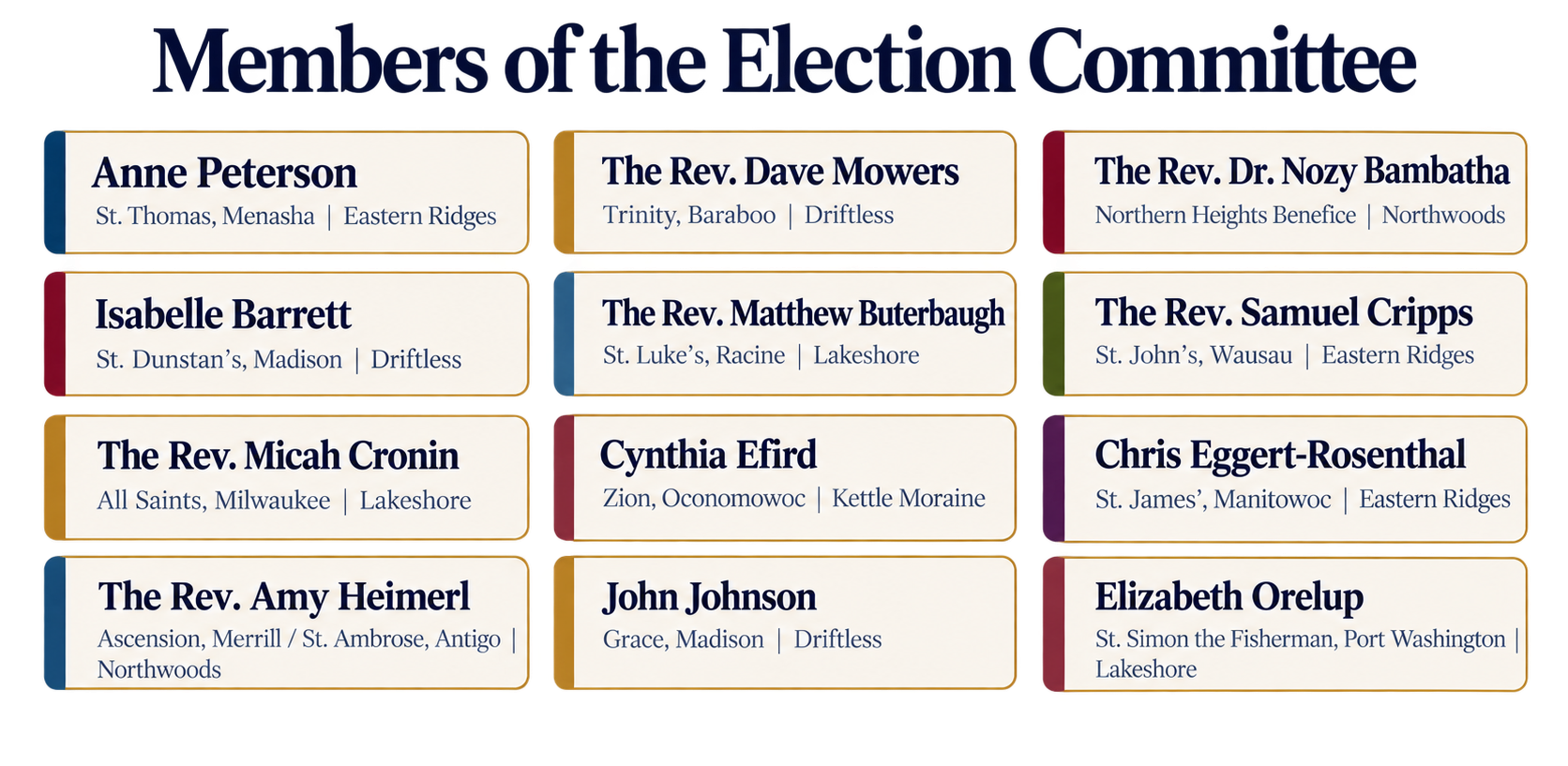
Election Committee was appointed during our 179th Annual Convention in Stevens Point this past weekend. Members are now listed on this page and are starting to do the work. Co-chairs Fr. Dave Mowers and Anne Peterson shared a report that was approved by the convention on the work thus far and the plan to execute, along with answering several questions from deputies at the convention. More info will be added by this committee as available.
Last updated: October 7, 2026.
This section is updated weekly, even in weeks with no new developments.
Our Journey Toward the 13th Bishop of Wisconsin
The election of a bishop is a process of prayer, listening, discernment, and shared decision-making. Follow the major milestones in the Diocese of Wisconsin's transition through consecration in 2028.
Election Committee Formed
The Standing Committee appoints the Election Committee, including lay and clergy representation from across the five Mission Regions.
Listening & Diocesan Profile
The Election Committee listens across the diocese to understand our ministries, challenges, opportunities, hopes, and the gifts we seek in our next bishop. That listening shapes the diocesan profile.
Leadership Retreat
The Standing Committee and Election Committee gather for a leadership retreat.
Diocesan Profile Published
The profile introduces prospective nominees to the Episcopal Diocese of Wisconsin and describes our identity, ministries, opportunities, and hopes for the next bishop.
Nominations Open
Nominations for the 13th Bishop of Wisconsin begin. Nominees move through the processes required by the Constitution and Canons, including background and reference checks and consultation with the Chancellor.
Nominee Information Shared
Information about nominees who successfully complete the required processes is shared with the diocese in preparation for the Special Nominating Convention.
Special Virtual Nominating Convention
The diocese gathers virtually to vote and determine the final slate of nominees for bishop.
Final Nominee Discernment
Members of the final slate complete the required medical and psychological evaluations and other preparations for the election.
Meet & Greets
People throughout Wisconsin will have opportunities to meet, hear from, and learn more about the final nominees.
Electing Convention
The Convention of the Episcopal Diocese of Wisconsin gathers to elect the 13th Bishop of Wisconsin.
Churchwide Consent Process
The bishop-elect enters the consent process required by the Constitution and Canons of The Episcopal Church. This process may take up to 120 days.
Consecration of the 13th Bishop of Wisconsin
God willing and the people consenting, the bishop-elect will be ordained and consecrated as the 13th Bishop of the Episcopal Diocese of Wisconsin.
Frequently Asked Questions
Learn more about how the bishop transition process works, who is responsible for each part of the process, and how members of the diocese can participate.
The Constitution and Canons adopted with the reunion of the Diocese of Wisconsin established a different model for episcopal elections. Rather than asking a Search Committee to narrow applicants to a slate, the process provides for broader participation by the diocese through a Special Nominating Convention.
No. The Election Committee performs some work traditionally associated with a Search Committee, including diocesan listening and development of a profile, but it does not independently choose the final slate of nominees.
The nomination period is anticipated to open after publication of the diocesan profile in February 2027. Additional instructions and requirements will be published here when nominations open.
Yes. Individuals are encouraged to apply themselves. If you know someone whose gifts would serve the diocese well in this work, you may also encourage that person to apply.
Members should anticipate significant involvement throughout the transition process, including listening and profile development, nominations, the Special Nominating Convention, meet-and-greets, and preparations for the Electing Convention.
Under the Constitution and Canons of the Diocese of Wisconsin, the Standing Committee has responsibility for overseeing the episcopal election process. The Standing Committee is being assisted by The Rt. Rev. Wayne Smith and The Rev. Canon Victor Conrado , consultants recommended by The Episcopal Church's Office of Leadership Development.
Although the Diocese of Wisconsin was reunified in 2024, the reunion restored a historic diocese rather than creating an entirely new one. The Diocese of Wisconsin was originally formed in 1847 and later divided as the Dioceses of Fond du Lac and Eau Claire were established and the remaining Diocese of Wisconsin became the Diocese of Milwaukee.
When the three historic dioceses reunited in 2024, The Rt. Rev. Matthew Gunter became the 12th Bishop of Wisconsin. The numbering therefore continues the historic succession of bishops of the Diocese of Wisconsin rather than beginning again with reunification. The bishop elected in 2027 will be the 13th Bishop of Wisconsin.
The Canons were written this way in response to concerns arising from episcopal election processes in other dioceses, where a search or nomination process could potentially be shaped toward a particular outcome, including through the composition of a search committee or by limiting a slate to candidates representing a particular viewpoint. Wisconsin's process was designed to reduce those risks and broaden participation.
Its goals are to:
- Draw on the widest possible input from across the diocese.
- Give each of the historic dioceses a voice in the process.
- Avoid confidential decisions being made by a small, unelected group without transparency.
- Above all, identify strong candidates who can work with the whole diocese in all its diversity.
Yes, although the model is not widely used in The Episcopal Church. The Diocese of Springfield (Illinois) and the Diocese of Cuba have used processes similar to this one. A related approach is also used more broadly in bishop elections within the Evangelical Lutheran Church in America (ELCA).
Benefits
- There is greater transparency about who enters the process and what qualifications they bring.
- The diocese has a longer period in which to interact with candidates and learn more about them.
- The process makes it clearer how the final slate develops.
- Input can be gathered from every parish and clergy person in the diocese about who should move forward to the final slate.
- The structure reduces the ability of an unelected group to shape the process around a particular ideological outcome.
Drawbacks
- There will be an additional convention, with the associated time and expense.
- Publishing names earlier in the process may discourage some prospective candidates who are not yet ready for their current parish or ministry setting to know they are discerning another call.
- The Election Committee will need to handle carefully any withdrawals that occur after preliminary nominees are published.
One of the common refrains from the Trialogue process was a call for a more decentralized administration. This Canon represents one of the ways that principle was built into the structure of the reunited diocese by creating opportunities for communicants to have a voice throughout the process.
The Canon is intended to reduce gatekeeping while creating room for the Holy Spirit to move through the wider diocesan community and for members of the diocese to participate meaningfully as the slate develops.
The most important thing to remember is that there are opportunities for members of the diocese to participate in nearly every stage of the process. Parishes are encouraged to regularly announce and discuss developments, create space for reflection and feedback, and direct that feedback to the appropriate transition leadership as the process moves forward.

Election Committee
What is an election Committee?
The Election Committee guides the Diocese of Wisconsin through the process of identifying and electing its next bishop. Rather than selecting or nominating candidates itself, the committee listens to the diocese to understand its hopes, priorities, and the gifts needed in the next bishop; develops the diocesan profile; receives and gathers nominations; and coordinates the nominating convention, candidate meet-and-greets, and electing convention in partnership with the Standing Committee and diocesan staff. Its work is grounded in prayer, confidentiality, hospitality, careful organization, and adherence to the established transition timeline.
Our Election Committee: